Advertisement
Most articles about solar savings assume you own a house with a big, sunny roof. But what if you rent an apartment, live in a condo, or own a mobile home? Does that mean solar savings are simply off the table? Not anymore. Thanks to newer programs and provisions in recent federal legislation, community solar for renters, seniors, and condo owners is a real and growing option — and you don't need to install a single panel to benefit.
Why Traditional Solar Doesn't Work for Everyone 55+
The federal Investment Tax Credit (ITC) gives homeowners a 30% tax credit on the cost of installing solar panels — a significant benefit when the average installation runs between $15,000 and $25,000 before incentives. But that program is designed for people who own a standalone home and have a roof they can legally modify.
If you're renting an apartment, living in a condo with an HOA that restricts rooftop modifications, or residing in a manufactured home community, you likely can't take advantage of that credit directly. And for many retirees on fixed incomes, even if you could install panels, the upfront cost — even with financing — may feel out of reach.
The good news: there are several smart alternatives designed specifically for people in your situation.
What Is Community Solar — and How Can It Help Renters and Seniors?
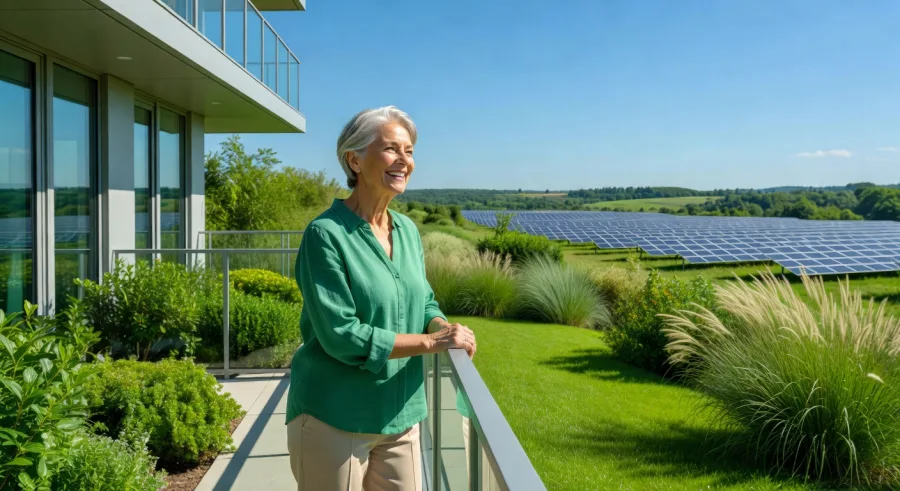
Community solar (sometimes called a solar garden or shared solar) is a program where a large solar installation is built in your region — on a farm, an open field, or an industrial rooftop — and local residents subscribe to a portion of the energy it produces. You don't own the panels. You don't install anything. You simply sign up and receive a credit on your monthly electric bill based on your share of the energy generated.
This is exactly how community solar for renters, seniors, and those without rooftop access works in practice. You keep your current utility, you don't change your electric provider, and you start seeing savings reflected on your bill — often ranging from 5% to 15% off, though amounts vary by program, state, and utility.
Who Is Community Solar Available To?
- Renters in apartments or rental homes
- Condo owners who can't modify shared or individual rooftops
- Mobile and manufactured home residents
- Homeowners whose roofs face the wrong direction or are shaded by trees
- Anyone whose home isn't suitable for traditional panel installation
Community solar programs are currently available in more than 20 states and expanding. Availability depends entirely on where you live, so checking your specific state or utility is the essential first step.
The Inflation Reduction Act and What It Means for Renters
The Inflation Reduction Act (IRA), signed into law in 2022, included provisions aimed at making clean energy more accessible to lower- and moderate-income Americans — including those who rent. One key piece of this legislation is the expansion of support for community solar programs, with a focus on reaching underserved communities.
Under certain IRA-funded initiatives, low-income renters and seniors may qualify for deeper discounts through subsidized community solar subscriptions. Some programs specifically target households earning below a certain percentage of the area median income, offering bill credits that exceed what market-rate subscribers receive. Eligibility thresholds and benefit amounts vary significantly by state and program, so it's worth investigating what's available in your area.
It's important to note that renters generally cannot claim the 30% federal solar tax credit directly, since it requires ownership of the installed system. However, the IRA created new pathways — including credits that flow through utilities and community solar providers — that can translate into real savings even without owning any equipment.
Utility Green Energy Programs: Another No-Panel Option
Even in states where community solar isn't yet available, many electric utilities offer green energy programs that let you pay a small premium — or sometimes no premium at all — to have your electricity matched with renewable energy, including solar. These are sometimes called green tariff programs or renewable energy certificates (RECs).
While these programs don't always reduce your bill, they do let you participate in the clean energy economy and, in some cases, can be paired with other savings programs. Check your utility's website or call their customer service line to ask what renewable or solar options are available for renters and apartment residents.
Questions to Ask Your Utility
- Do you offer a community solar or shared solar program?
- Is there a green energy or renewable option for renters?
- Are there income-based discounts or low-income solar programs?
- How do I sign up, and is there a waitlist?
What to Watch Out For
Community solar is legitimate and growing, but as with any financial program, it pays to read the fine print before signing up.
- Contract length: Some subscriptions require a multi-year commitment. Look for programs with flexible or month-to-month terms if you're uncertain about your living situation.
- Cancellation terms: Understand what happens if you move. Many programs allow you to cancel or transfer, but terms vary.
- Savings guarantees: Reputable programs will clearly explain how your bill credits are calculated. Be cautious of any company that promises specific savings without explaining the method.
- Upfront fees: Most community solar subscriptions are free to join. Be wary of programs that charge enrollment fees.
How to Find Community Solar for Renters and Seniors in Your Area
The best place to start is EnergySage (energysage.com), a free, independent marketplace that lists community solar programs by zip code. You can compare options, read reviews, and sign up — all without being pressured by a salesperson.
The U.S. Department of Energy also maintains resources on community solar through its Office of Energy Efficiency and Renewable Energy at energy.gov. Their community solar finder tool can help you identify programs available in your state.
Additionally, your state energy office is a valuable resource. Most states have a dedicated office that tracks solar incentives, community programs, and utility offerings. A quick search for your state name plus the words state energy office will get you there.
Bottom line: You don't need a rooftop, a large tax bill, or a big investment to start saving with solar. Community solar for renters and seniors is designed for exactly your situation — and it's more accessible than most people realize.
Your Next Step
If you're ready to explore your options, start by visiting energysage.com/community-solar and entering your zip code. It's free to search, there's no obligation, and you could start seeing savings on your electric bill within a few months. You can also call your utility provider directly and ask specifically about community solar or green energy programs for renters. The savings may be smaller than a full rooftop installation — but they're real, they're accessible, and they don't require you to change a single thing about where you live.
Advertisement