Advertisement
Why So Many Seniors Miss Out on Property Tax Relief
If you have ever applied for a senior property tax exemption and been turned down because your income was too high, you are not alone. Thousands of older homeowners across the country are unknowingly disqualified every year — not because they are wealthy, but because the household income calculation for senior property tax exemptions counts far more than most people expect. Social Security benefits, pension checks, IRA withdrawals, and even interest from tax-exempt municipal bonds can all push your reported income over the limit. The good news is that with the right planning, many seniors can legally restructure how and when they receive income to fall within qualifying thresholds.
What Counts as Household Income for a Senior Property Tax Exemption?
Most people think of household income as what shows up on their federal tax return. But for property tax exemption programs, local assessors often use a much broader definition — one that can catch seniors completely off guard.
Depending on your state and county, the following income sources may all be counted toward your household income limit:
- Social Security benefits — including the portion that is not taxable on your federal return
- Pension and annuity payments — from both public and private plans
- IRA and 401(k) distributions — including required minimum distributions (RMDs)
- Capital gains — from the sale of stocks, property, or other assets
- Dividends and interest — even from tax-exempt municipal bonds
- Rental income — net or gross, depending on the program
- Veterans benefits — in some jurisdictions
This is a very different picture from what the IRS asks about on Form 1040. For property tax purposes, assessors are often looking at your total economic resources, not just your taxable income. If you did not know that your full Social Security benefit — not just the taxable 85 percent — was being counted, that alone could explain a denial.
Why the Household Income Calculation for Social Security Catches Seniors Off Guard
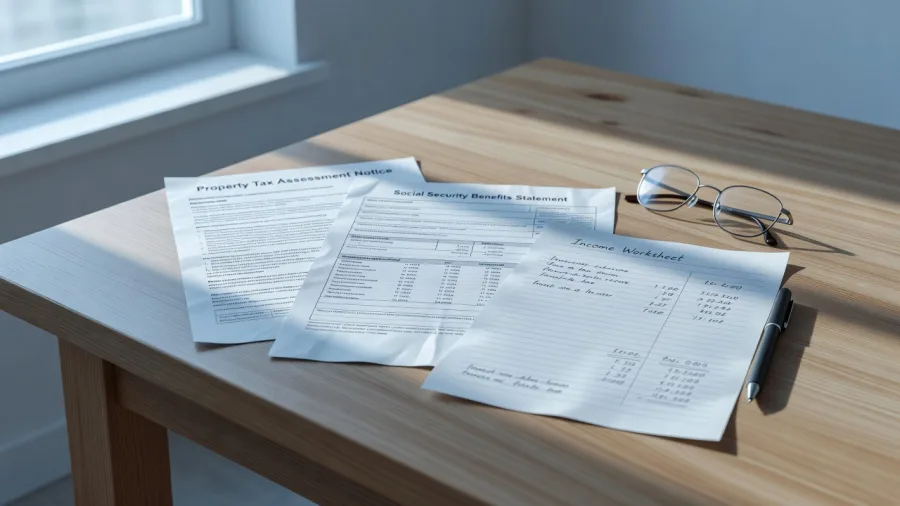
Here is a common scenario. A retired couple receives $28,000 per year in combined Social Security benefits. On their federal tax return, only a portion of that is taxable. But when they apply for a local senior property tax exemption, the assessor counts the full $28,000. Add in a modest pension of $12,000 and an IRA distribution of $8,000, and their reported household income for exemption purposes suddenly reaches $48,000 — well above the threshold in many counties.
Meanwhile, their actual spending power and financial flexibility may be quite limited. Fixed costs like insurance, utilities, and medical expenses can consume a large share of that income. The exemption program was designed to help people in exactly their situation, but the income calculation works against them.
Understanding exactly how your county defines household income is the single most important step you can take before applying for a senior property tax exemption.
Legal Strategies to Reduce Your Reportable Household Income
The word legal is important here. The goal is not to hide income or misrepresent your finances — it is to make smart decisions about timing and structure so that your reportable household income falls within the limits set by your local program. Here are several approaches worth discussing with a financial advisor or tax professional.
1. Adjust the Timing of IRA Distributions
If you are taking voluntary IRA distributions on top of your required minimum distributions, consider whether you truly need those extra withdrawals in the current year. Reducing or eliminating discretionary IRA withdrawals in the year you plan to apply for an exemption can meaningfully lower your reportable household income.
2. Delay or Retime Capital Gains Realizations
If you are planning to sell investments, real estate, or other assets, the timing of those transactions matters. A large capital gain in the same year as your exemption application could push you over the income limit. Consider whether the sale can wait until after the assessment period, or whether losses in your portfolio can be harvested to offset gains.
3. Understand Which Social Security Amount Is Being Counted
Ask your county assessor's office directly: do they count gross Social Security benefits or only the taxable portion? The answer varies by state and program. If only the taxable portion counts in your jurisdiction, that is already a meaningful difference in how your income is calculated.
4. Review How Rental and Business Income Is Measured
Some programs count net rental income after expenses, while others count gross receipts. If you receive rental income, understanding this distinction — and properly documenting your deductible expenses — could reduce your countable income significantly.
5. Time Your Application Strategically
Many exemption programs use income from the prior calendar year as the basis for eligibility. If you had an unusually high-income year due to a one-time event like a home sale or a large distribution, it may be worth waiting until the following year to apply, when your income returns to normal levels.
How to Find Out Exactly What Your County Counts
There is no single national standard for how household income is defined in senior property tax exemption programs. Each state sets its own rules, and in many states, individual counties have additional discretion. That means the rules in your county may be meaningfully different from a neighboring county just miles away.
To get accurate information for your specific situation, take the following steps:
- Contact your county tax assessor's office directly and ask for a written description of the income sources counted toward the household income threshold
- Ask whether any deductions are allowed — such as unreimbursed medical expenses, which some programs subtract from gross income
- Request any worksheets or instruction guides that accompany the exemption application
- If your county has a senior services office or Area Agency on Aging, they may offer free assistance navigating the application process
Other Income-Related Exemption Features to Know About
Beyond standard exemptions, some states offer property tax freezes that lock in your home's assessed value — protecting you from rising assessments even if you do not qualify for a full income-based exemption. Others offer circuit breaker programs that cap the percentage of your income that can go toward property taxes. These programs may use different income definitions and different thresholds, so even if you were denied for one program, you may qualify for another.
Take Action Before the Next Deadline
Property tax exemption application deadlines vary by state and county, and missing the window can mean waiting another full year for relief. The most important next step you can take right now is to call your county tax assessor's office, ask about all available senior exemption programs, and request the specific income definitions used for each one.
You worked hard for the benefits and retirement income you receive. Understanding how the household income calculation for senior property tax exemptions works — and how Social Security, pensions, and other income sources are counted — puts you in a much stronger position to claim every dollar of relief you are legally entitled to. Talk to a tax professional or financial advisor about your specific situation, and do not assume a past denial means you will always be disqualified.
Advertisement