Advertisement
Can You Use SNAP and Senior Farmers Market Vouchers Together?
If you already receive SNAP benefits, you might assume that covers everything you need when it comes to food assistance. But there is another program that many low-income seniors overlook entirely — and the good news is that you can use SNAP and senior farmers market vouchers together at the same time. These are two completely separate programs, and qualifying for one does not disqualify you from the other. For seniors on a tight budget, combining both can mean significantly more fresh fruits and vegetables on the table throughout the growing season.
What Is the Senior Farmers Market Nutrition Program (SFMNP)?
The Senior Farmers Market Nutrition Program, commonly called SFMNP, is a federally funded program administered by individual state agencies. It provides free vouchers to low-income seniors that can be used to purchase fresh fruits, vegetables, and herbs directly from farmers markets, roadside farm stands, and community-supported agriculture (CSA) programs.
Here are the basics of how the program works:
- Who qualifies: Generally, applicants must be 60 years of age or older and meet low-income guidelines set by their state. Income limits are typically based on a percentage of the federal poverty level, but the exact threshold varies by state.
- What you receive: Voucher amounts vary by state and are updated annually. Most participants receive somewhere between $20 and $50 worth of vouchers per season, though some states may offer more or less depending on available funding.
- When you can use them: SFMNP is a seasonal program. Vouchers are typically issued in late spring or early summer and must be used by the end of the local growing season, often in October or November.
- Where to use them: Participating farmers markets, roadside stands, and CSA programs accept SFMNP vouchers. Not every vendor at every market participates, so it helps to ask ahead of time.
- What you can buy: Fresh, locally grown fruits, vegetables, and herbs. Processed or preserved items, like jams or pickled goods, are generally not eligible.
How SFMNP and SNAP Are Different
It is easy to assume these two programs overlap, but they operate completely independently of each other. SNAP — the Supplemental Nutrition Assistance Program — provides monthly electronic benefits loaded onto an EBT card that can be used at most grocery stores and many farmers markets. SFMNP, on the other hand, provides paper vouchers or coupons specifically for use at local farm vendors during the growing season.
The key differences come down to funding source, administration, and how benefits are delivered. SNAP is managed at the federal level through the U.S. Department of Agriculture and distributed by state social services agencies. SFMNP is also USDA-funded but administered separately, often through state departments of agriculture or aging services. Because they come from different program budgets and have different eligibility processes, receiving one does not affect your eligibility for the other.
Receiving SNAP benefits does not disqualify you from SFMNP. In fact, being a current SNAP recipient may actually help you qualify more easily, since you have already demonstrated low-income status.
Can You Use SNAP and Senior Farmers Market Vouchers at the Same Place?
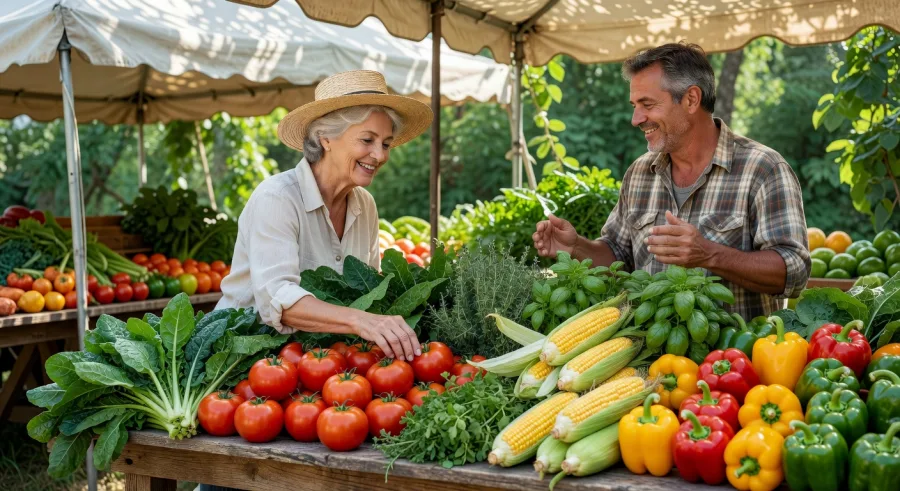
Yes — and this is where the real value of stacking both programs becomes clear. Many farmers markets now accept both SNAP EBT cards and SFMNP vouchers. That means on a single trip to your local market, you could use your SFMNP vouchers to cover a bundle of fresh produce at no cost, and then use your SNAP benefits to purchase additional items beyond what the vouchers cover.
Some markets even offer bonus matching programs for SNAP users, where spending SNAP benefits earns you additional tokens to spend on produce. When you layer that on top of SFMNP vouchers, a single farmers market visit can go very far for a senior on a fixed income.
Tips for Getting the Most Out of Both Programs
- Apply for SFMNP early. Many states have limited voucher supplies and distribute them on a first-come, first-served basis. Once funding runs out for the season, enrollment typically closes.
- Check which vendors are authorized. Ask the farmers market manager which vendors accept SFMNP vouchers and which accept SNAP EBT. Not every booth participates in both.
- Ask about SNAP matching programs. Programs like Double Up Food Bucks operate in many states and can double the value of SNAP dollars spent on fruits and vegetables at participating markets.
- Plan your visits around peak season. Produce variety and availability are highest mid-summer through early fall, which also aligns with when SFMNP vouchers are active.
- Keep your vouchers somewhere safe. SFMNP vouchers are treated like cash. Lost or damaged vouchers typically cannot be replaced.
How to Find Out If You Qualify for SFMNP
Eligibility requirements and enrollment processes vary from state to state, so the best starting point is to contact your state agency directly. SFMNP is often administered through your state's department of agriculture, department of aging, or a similar office. In some states, you may be able to enroll through a local Area Agency on Aging, a senior center, or a community health organization.
You can also start your search through the USDA Food and Nutrition Service website, which maintains information about SFMNP and links to state contacts. Searching for your state name along with the phrase Senior Farmers Market Nutrition Program is a quick way to find the right local office.
If you already receive SNAP, Medicaid, or Supplemental Security Income (SSI), you may find the SFMNP application process straightforward, since your income has already been verified through those programs. Some states allow simplified enrollment for seniors already receiving other benefits.
Do Not Leave Free Benefits on the Table
Many eligible seniors never apply for SFMNP simply because they do not know it exists. If you are 60 or older, living on a limited income, and already stretching your SNAP dollars as far as they can go, SFMNP vouchers are an additional resource you have earned access to — completely separate from any other benefits you receive.
Fresh produce is one of the most important parts of a healthy diet, and these programs exist specifically to make it more accessible for older Americans with limited budgets. Using SNAP and senior farmers market vouchers together is not double-dipping — it is exactly what these programs are designed for.
Your Next Step
To find out if SFMNP is available in your state and whether you qualify, visit the USDA Food and Nutrition Service website at fns.usda.gov and search for the Senior Farmers Market Nutrition Program. You can also call your local Area Agency on Aging — reachable through the Eldercare Locator at 1-800-677-1116 — and ask whether SFMNP enrollment is open in your area. Do not wait too long: vouchers are seasonal and supplies are limited, so earlier in the year is always better.
Advertisement