Advertisement
The Real Reason Your Gutters Are Failing (It May Not Be the Gutters)
If you have been dealing with water pooling near your foundation, soggy landscaping, or a damp basement, your first instinct might be to replace your gutters. And you may be right — but here is what many homeowners over 55 do not realize before spending $1,000 to $3,000 on new gutters: if the proper gutter pitch, sizing, and downspout placement are not corrected during installation, your brand-new gutters will cause the exact same water damage problems as the old ones. Understanding these three factors is the most important thing you can do to protect your home and your investment before any contractor shows up at your door.
What Is Gutter Pitch — and Why Does It Matter for Home Water Damage?
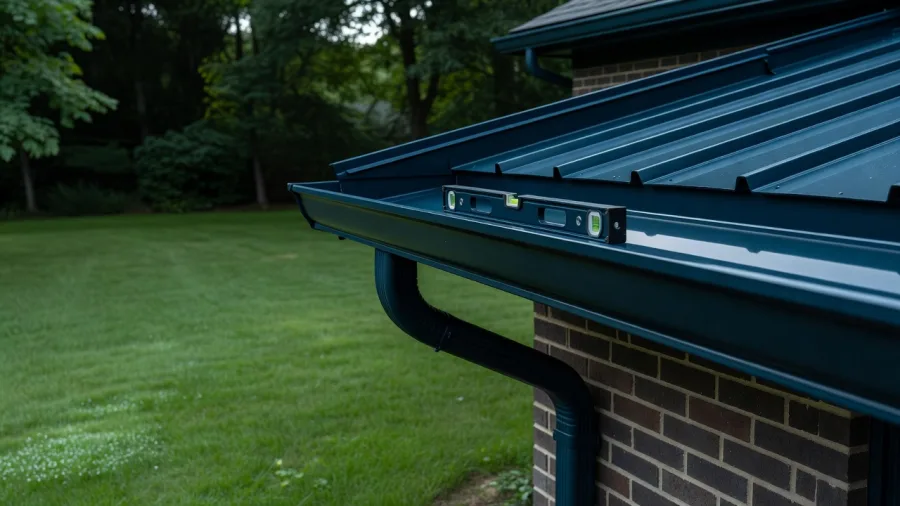
Gutter pitch refers to the slight downward angle at which gutters are installed along your roofline. This angle is what allows rainwater to flow from the far end of your gutter toward the downspout instead of sitting still and overflowing. Most people assume gutters are installed perfectly level, but they should not be.
The standard recommendation is a slope of roughly one-quarter inch of drop for every ten feet of gutter run. That may not sound like much, but it makes an enormous difference. Gutters with too little pitch allow water to pool and stagnate, which accelerates rust, rot, and sagging. Gutters with too much pitch cause water to rush past the downspout opening too quickly, leading to overflow during heavy rain.
Here is what this means for you as a homeowner: if your current gutters are clogged, overflowing, or pulling away from the fascia board, the problem may not be the material — it may be that the original installer set the wrong pitch. A gutter replacement that uses the same incorrect angle will fail just as fast.
What to Ask Your Contractor About Pitch
- What slope will you use, and how will you verify it during installation?
- Will you re-evaluate the pitch along the full length of the gutter run?
- Are there any low spots in my current system that need correction?
Gutter Sizing: Bigger Is Not Always Better, But Undersized Is Always a Problem
Most homes built before the 1990s were equipped with five-inch K-style gutters, which were considered standard at the time. But rooflines vary significantly in size, pitch, and surface area — and a gutter that is too narrow for your roof simply cannot handle the volume of water that flows off during a moderate rainstorm, let alone a heavy downpour.
Proper gutter sizing takes into account several factors, including the square footage of your roof surface, the pitch of your roof itself, and the average rainfall intensity in your region. Homes with steeper roofs shed water faster and need larger gutters to keep up. A contractor who installs five-inch gutters on a steeply pitched roof with a large surface area is setting you up for overflow problems regardless of how well the gutters are made.
Six-inch gutters are increasingly common and are often the right choice for larger homes or homes in areas with frequent heavy rainfall. They carry significantly more water volume and, when paired with correctly sized downspouts, can dramatically reduce the overflow that sends water straight down your foundation walls.
For seniors on a fixed income, this is especially important to get right the first time. Foundational water damage from bad gutter drainage can cost $5,000 to $10,000 or more in repairs — a bill that dwarfs the cost of simply installing the right size gutter upfront.
Questions to Ask About Gutter Sizing
- Have you calculated the drainage area of my roof to determine the right gutter width?
- Should I be upgrading from five-inch to six-inch gutters based on my roof and local rainfall?
- Are my downspouts sized to match the gutters you are installing?
Downspout Placement: The Most Overlooked Factor in Proper Gutter Drainage
Even perfectly pitched and properly sized gutters will fail to protect your home if the downspouts are placed incorrectly. Proper gutter pitch, sizing, and downspout placement work as a system — and downspouts are where that system either succeeds or breaks down.
Downspouts need to be positioned at intervals that prevent water from backing up in long gutter runs. As a general rule, a single downspout can handle roughly thirty to forty feet of gutter. Longer runs need multiple downspouts. Homes with only one downspout per side — which is common in older construction — are frequently overwhelmed during rain events, regardless of gutter quality.
Equally important is where the downspout discharges water. Downspouts that empty right at the base of your home are one of the leading causes of basement flooding, foundation erosion, and mold growth. Extensions or underground drainage pipes should carry water at least four to six feet away from your foundation — and ideally into a sloped yard or drainage area that guides water away from the structure entirely.
Landscaping around the base of your home also plays a role. If the grade of your yard slopes toward your foundation rather than away from it, even perfect gutter drainage can still funnel water toward your home. A good contractor will flag this as part of the conversation.
Downspout Red Flags to Watch For
- Downspouts that empty directly onto soil at the base of your home
- Gutter runs longer than forty feet with only one downspout
- Downspouts that drain into areas where water visibly pools after rain
- No downspout extensions or underground drainage leading away from the foundation
Seamless Gutters and Gutter Guards: Worth the Upgrade?
Once you have the fundamentals right — pitch, sizing, and placement — material choice becomes the next decision. Seamless gutters are formed from a single continuous piece of metal cut to fit your home exactly, which eliminates the joints where sectional gutters commonly leak. They tend to last longer, look cleaner, and require less maintenance over time. For homeowners who want a low-hassle solution, seamless aluminum gutters are generally the preferred choice.
Gutter guards can also be a smart addition, particularly for older homeowners who prefer to avoid climbing ladders for seasonal cleaning. Quality gutter guards reduce debris buildup and help maintain consistent water flow — which supports the pitch and sizing you paid to have installed correctly.
Your Next Step: Get the Right Assessment Before You Sign Any Contract
Before agreeing to any gutter replacement, ask for a written assessment that addresses pitch calculation, gutter sizing based on your roof area, downspout placement and discharge distance, and any grading concerns around your foundation. A contractor who cannot or will not answer these questions may be planning to install a new version of the same problem you already have.
Visit SavingsHunter.com to explore more home improvement guides for Americans 55 and older, including tips on finding qualified local contractors, questions to ask before any home project, and programs that may help offset the cost of critical home repairs. Getting these details right before you replace your gutters is the single best way to protect your home — and your peace of mind — for years to come.
Advertisement