Advertisement
If you're an older homeowner, you've likely heard that gutters need replacing eventually. But what most people don't realize is that by the time gutters start visibly failing, the damage has often already spread somewhere far more serious — into the fascia boards and soffits hidden just behind and above those gutters. For anyone focused on gutter replacement fascia soffit rot repair for older homeowners, understanding this silent deterioration cycle is the difference between a manageable fix and a five-figure roofline disaster.
What Are Fascia and Soffit — and Why Do They Matter?
Most homeowners are familiar with gutters but far less familiar with the structural components that hold them in place. The fascia is the vertical board that runs along the lower edge of your roofline, directly behind your gutters. The soffit is the horizontal surface tucked underneath the roof overhang, between the fascia and the exterior wall of your home.
These two components do more than look decorative. Fascia boards are literally what your gutters are nailed or screwed into — they are the anchor point for your entire gutter system. Soffits, meanwhile, cover and protect the rafters and eaves of your roof while also providing critical ventilation for your attic. When either one begins to rot, the consequences ripple outward quickly.
How Failing Gutters Accelerate Fascia and Soffit Rot
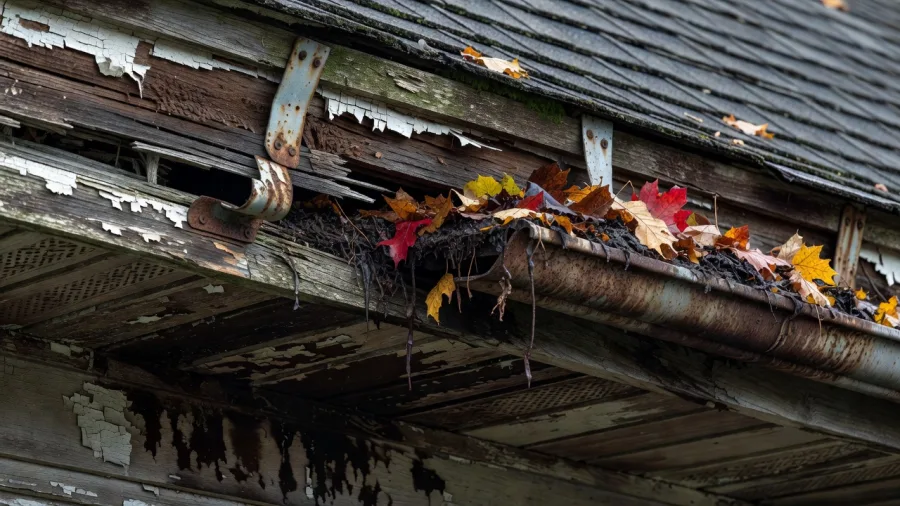
Here is where the damage cycle becomes important to understand. When gutters sag, pull away from the roofline, or develop leaks at their seams, water does not simply fall harmlessly to the ground. Instead, it seeps behind the gutter channel and soaks directly into the fascia board. Wood that stays wet begins to soften, swell, and eventually rot — sometimes within a single rainy season.
Clogged gutters make this even worse. When gutters overflow because they are packed with leaves and debris, water cascades over the back edge in a constant sheet, bathing the fascia in moisture every time it rains. Over months and years, that repeated soaking causes the wood to decay from the inside out. Because the gutter itself covers the fascia, homeowners rarely see the rot forming until it has progressed significantly.
Soffits suffer too. As fascia boards rot and lose their structural integrity, gaps open up at the roofline junction. Moisture infiltrates the soffit cavity, promoting mold growth and wood decay. Worse, gaps in the soffit invite insects, birds, and small animals into your attic space — creating a secondary set of expensive problems entirely.
The Attic Ventilation Connection
Soffits serve a ventilation function that most homeowners take completely for granted. Properly functioning soffit vents allow cool outside air to flow into the attic, pushing hot, humid air out through ridge vents at the peak of the roof. This airflow prevents moisture buildup that leads to mold and wood rot inside the attic itself, and it helps regulate temperatures that affect your roof shingles.
When soffit rot blocks or destroys these vents, attic ventilation is compromised. In summer, trapped heat accelerates shingle deterioration. In winter, warm moist air from inside the home condenses in a poorly ventilated attic and creates conditions ripe for mold. What started as a gutter overflow problem has now reached deep into your home's structure.
Why Older Homeowners Face Higher Risk
If you've lived in your home for decades, your gutters may be original or near-original to the house. Sectional gutters — the kind with visible seams every few feet — were standard installation for most of the twentieth century. Over time, those seams expand, contract, and eventually open up, creating the exact leak points that soak fascia boards season after season.
Additionally, many older homes have wood fascia boards rather than the aluminum-wrapped or composite alternatives used in newer construction. While wood is durable when kept dry, it is far more vulnerable to prolonged moisture exposure. Older homeowners living on fixed incomes often delay gutter repairs simply because the gutters appear functional from the ground — not realizing the hidden deterioration building up behind them.
Gutter Replacement Fascia Soffit Rot Repair: Understanding the Real Cost of Waiting
This is the financial reality that makes early action so important. A straightforward gutter replacement on an average home typically costs between $1,000 and $3,000 — a meaningful expense, but a manageable one. However, once fascia and soffit rot enter the picture, the scope of work expands considerably.
- Fascia board replacement adds labor and material costs, especially if rot has spread across multiple sections of the roofline.
- Soffit repair or replacement requires additional carpentry work and may involve restoring or replacing vent panels.
- Foundation damage caused by years of misdirected water runoff can run $5,000 to $10,000 or more — costs that dwarf the price of timely gutter replacement.
- Attic mold remediation, if poor soffit ventilation has allowed moisture damage to accumulate, is an additional expense that can reach thousands of dollars depending on the extent of growth.
Addressing gutters before rot sets in keeps the project scope narrow. Waiting until the fascia crumbles turns a single contractor visit into a multi-trade roofline rehabilitation.
What to Ask a Contractor Before Any Work Begins
If you are scheduling a gutter inspection or replacement estimate, make sure the contractor specifically examines the fascia and soffit condition before quoting the job. A reputable contractor will probe fascia boards for softness, check soffit panels for staining or sagging, and assess whether existing rot requires board replacement before new gutters can be properly anchored.
Ask specifically about seamless gutters, which are fabricated on-site as a single continuous run with far fewer seam points than sectional gutters. Seamless aluminum gutters dramatically reduce the leak points that cause fascia soaking in the first place, and they tend to last significantly longer. Ask about gutter guards as well — quality gutter guard systems reduce the frequency of cleaning and prevent the overflow conditions that accelerate soffit and fascia damage.
Protecting Your Investment as a Homeowner 55 and Older
Your home is likely one of your most significant financial assets, and protecting its structural integrity is one of the most practical things you can do in retirement. The interconnected damage cycle of failing gutters, rotting fascia, and compromised soffits is largely preventable with timely inspection and proactive replacement.
A small investment in gutter replacement today can protect tens of thousands of dollars in foundation, roofline, and attic structural value over the coming decades.
Many states and localities offer assistance programs for older homeowners facing necessary home repairs, including weatherization grants, low-interest home repair loans, and nonprofit rehabilitation assistance. Income eligibility and program availability vary by state and year, so it is worth exploring what may be available in your area before paying entirely out of pocket.
Your Next Step: Don't Wait Until You Can See the Damage
If your gutters are more than 15 to 20 years old, pulling away from the roofline, or visibly sagging, the time to act is now — before the damage migrates into your fascia and soffit. Start by scheduling a professional gutter inspection with a licensed contractor who will assess not just the gutters themselves but the full roofline system they depend on.
Visit SavingsHunter.com to explore home improvement savings programs available to older Americans, including resources that may help offset the cost of gutter replacement fascia soffit rot repair for older homeowners in your state. Catching this problem early is the single most effective step you can take to protect your home's structure and your financial peace of mind.
Advertisement